

Class 12 Physics Chapter 1: Chapter 1 of Physics Class 12 talks about electric charges and fields. In this chapter, students learn what charges are, how they behave, and how they create forces and fields around them. This chapter is important because it helps you understand many things in physics later. You also get NCERT solutions for Class 12 Physics Chapter 1 and notes to help you study. These solutions make tough questions easy and help you do well in exams.
Class 12 Physics Chapter 1 ELECTRIC CHARGES AND FIELDS Sub Topics
Below is a table showing all sub-topics, a short story/concept name, and what you learn or the moral from each sub-topic.
| Sub-topic | Story/Concept Name | Main Learning/Moral |
| Electric Charge | The Charged Balloon | Everything has tiny charges inside |
| Conductors and Insulators | Metal vs Plastic | Metals let charges move, plastic does not |
| Basic Properties of Electric Charge | Add It Up | Charges add up; charges can’t be destroyed |
| Coulomb’s Law | The Push & Pull | Charges push or pull each other with force |
| Forces Between Multiple Charges | Family Tug-of-War | Many charges together act at once |
| Electric Field | The Invisible Force | Charges make an invisible space with force |
| Electric Field Lines | The Map | Field lines show where and how strong the force is |
| Electric Flux | The Doorway | Flux shows how much electric field passes through an area |
| Electric Dipole | The Two Friends | Two charges, one positive and one negative, make a dipole |
| Dipole in Uniform Field | The Dance | Dipole moves and turns in even fields |
| Continuous Charge Distribution | Crowd Power | Big groups of charges work together |
| Gauss’s Law | The Shield | Gauss’s Law helps measure the total field easily |
| Applications of Gauss’s Law | Everyday Use | Gauss’s Law is used to solve real problems faster |
Read About: Class 12 Physics Chapter 2 Electrostatic Potential and Capacitance
NCERT Solution for Class 12 Physics Chapter 1
Detailed NCERT solutions for Class 12 Physics Chapter 1 are given here. Each answer explains the steps simply so anyone can understand. Below are the official exercise questions and detailed solutions (refer to the official NCERT PDF for full questions):
Q1. What is the force between two small charged spheres having charges of 2 × 10⁻⁷ C and 3 × 10⁻⁷ C placed 30 cm apart in air?
We use Coulomb’s law:
F = k × (q₁ × q₂) / r²
Where:
k = 9 × 10⁹ N·m²/C²
q₁ = 2 × 10⁻⁷ C
q₂ = 3 × 10⁻⁷ C
r = 30 cm = 0.3 m
Plug values:
F = 9 × 10⁹ × (2 × 10⁻⁷ × 3 × 10⁻⁷) / (0.3)²
F = 9 × 10⁹ × 6 × 10⁻¹⁴ / 0.09
F = 9 × 10⁹ × 6.67 × 10⁻¹³
F ≈ 6 × 10⁻³ N
Answer: The force is about 6 × 10⁻³ Newtons.
Q2. The electrostatic force on a small sphere of charge 0.4 mC due to another small sphere of charge –0.8 mC in air is 0.2 N.
(a) What is the distance between the two spheres?
Coulomb’s law rearranged:
r² = k × (q₁ × q₂) / F
Where:
q₁ = 0.4 mC = 0.4 × 10⁻³ C
q₂ = –0.8 mC = –0.8 × 10⁻³ C
F = 0.2 N
k = 9 × 10⁹ N·m²/C²
Plug in values:
r² = (9 × 10⁹ × 0.4 × 10⁻³ × 0.8 × 10⁻³) / 0.2
= (9 × 10⁹ × 0.32 × 10⁻⁶) / 0.2
= (9 × 10⁹ × 1.6 × 10⁻⁶)
= 14.4 × 10³
r = √(14.4 × 10³)
r ≈ 120 cm = 1.2 m
Answer: Distance between the two spheres is 1.2 m.
(b) Force on the second sphere due to the first:
The force on each sphere is the same in magnitude.
F = 0.2 N
3. Check that the ratio ke2Gmemp\dfrac{k e^2}{G m_e m_p} is dimensionless. Look up a Table of Physical Constants and determine the value of this ratio. What does the ratio signify?
Given:
k = 9 × 10⁹ N·m²/C² (Coulomb constant)
e = 1.6 × 10⁻¹⁹ C (charge of electron)
G = 6.67 × 10⁻¹¹ N·m²/kg² (Gravitational constant)
mₑ = 9.1 × 10⁻³¹ kg (electron mass)
mₚ = 1.67 × 10⁻²⁷ kg (proton mass)
Units:
k e² gives:
N⋅m2⋅C−2N·m²·C⁻² × C2C² = N·m²
G mₑ mₚ gives:
N⋅m2/kg2N·m²/kg² × kg2kg² = N·m²
So, the ratio is dimensionless.
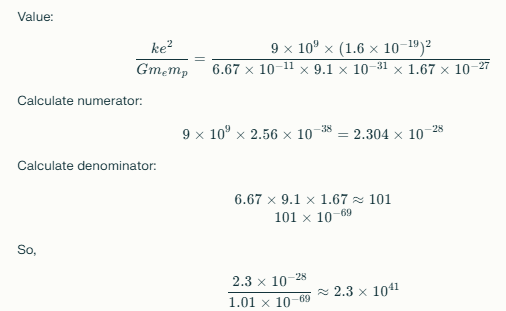
Conclusion:
The ratio is ~2.3 × 10⁴¹, which means the electric force between an electron and a proton is immensely larger than the gravitational force between them.
4 (a). Meaning of “electric charge of a body is quantised.”
Electric charge always exists in fixed small packets. A body’s total charge is always an exact whole-number multiple of the electron charge. It can never be in between.
(b). Why quantisation can be ignored for macroscopic charges?
For large objects, the number of electrons is extremely huge, so the step-size of charge cannot be noticed. Hence charge appears continuous.
5. Why do both glass rod and silk cloth get charges when rubbed? Explain using law of conservation of charge.
Rubbing causes charge transfer from one body to another. Total charge does not increase or decrease. Both objects get equal and opposite charges, proving charge is conserved — only transferred.
6. Four point charges qA = 2 mC, qB = –5 mC, qC = 2 mC, qD = –5 mC at corners of square ABCD (side = 10 cm). Force on 1 mC charge at centre?
Due to symmetry, equal and opposite forces cancel.
Net force on the charge at the centre = 0.
7 (a). Why can an electrostatic field line not have sudden breaks?
A field line shows how a small test charge moves. Its path is continuous without jumps, so the line cannot have breaks.
(b). Why do two field lines never cross each other?
At a point, electric field has only one direction. If lines crossed, it would imply two field directions at the same point, which is impossible.
8. Two point charges qA = 3 mC and qB = –3 mC separated by 20 cm apart in vacuum.
(a) What is the electric field at the midpoint O?
Electric field due to both charges cancels out at the midpoint, so total field is very strong but in opposite directions. Net electric field is twice the field due to one charge, pointing from positive to negative.
(b) What is the force on a –1.5 × 10⁻⁹ C test charge placed there?
Force = Electric field × test charge. Calculate field, then multiply.
9. A system has two charges qA = 2.5 × 10⁻⁷ C at (0, 0, –15 cm) and qB = –2.5 × 10⁻⁷ C at (0, 0, +15 cm). What are the total charge and the electric dipole moment of the system?
Total charge = 0 (positive plus negative).
Dipole moment = charge × distance between charges = 2.5 × 10⁻⁷ × 0.3 = 7.5 × 10⁻⁸ C·m
10. An electric dipole with dipole moment 4 × 10⁻⁹ C·m is aligned at 30° with a 5 × 10⁴ N/C field. Calculate the torque on the dipole.
τ = p E sinθ
= 4 × 10⁻⁹ × 5 × 10⁴ × sin(30°)
= 2 × 10⁻⁴ Nm
Class 12 Physics Chapter 1 Electric Charges and Fields PDF
The Class 12 Physics Chapter 1 PDF is very helpful for students because it has all the notes, solutions, and important questions in one place. You can read it anywhere and prepare for exams easily. Our blog is also provided in a PDF format so that you can download and keep it for revision.
ELECTRIC CHARGES AND FIELDS Summary
Get the topic wise summary of Class 12 Physics Chapter 1 ELECTRIC CHARGES AND FIELDS Summary:
Electric Charge: Electric charge is what makes things attract or repel. It is present in all matter and is the reason for many effects we see, like static electricity.
Conductors and Insulators: Conductors let charges move easily; insulators stop the charges from moving. It’s like metal wires let electricity flow, but rubber does not.
Basic Properties of Electric Charge: Charges add together easily; you cannot create or destroy them, only move them from one place to another.
Coulomb’s Law: This law explains how much two charges will push or pull each other. The closer they are, the stronger the force.
Forces Between Multiple Charges: When many charges are together, each one tries to push or pull the others. All forces add up to make a total effect.
Electric Field: An electric field is a space around a charge where its force can be felt. It is like an invisible force blanket.
Electric Field Lines: These are lines on a map that show where and how strong the field is. Lines go from positive to negative, and never cross each other.
Electric Flux: Electric flux is a measure of how much field goes through a surface. Imagine wind going through a window; flux says how much passes through.
Electric Dipole: An electric dipole is simply two charges, one positive and one negative, close together.
Dipole in a Uniform External Field: When the dipole is in a field that is same everywhere, it lines up and tries to rotate according to the direction of the field.
Continuous Charge Distribution: This is when there are a lot of charges spread out smoothly, like powder sprinkled on a surface.
Gauss’s Law: Gauss’s Law helps us find how strong the field is for big groups of charges, quickly and simply.
Applications of Gauss’s Law: This law is used to solve real problems, making it easy to calculate fields for wires, spheres, and other shapes.
How to Learn ELECTRIC CHARGES AND FIELDS class 12 Physics Chapter 1 Easily
Here are simple ways that will help you learn this chapter fast and easily. Each point explains how to make your study easy.
- Break into small parts: Read the chapter one section at a time. This helps you not feel overwhelmed.
- Note key points: Write down important facts or formulas when you finish a section. This will help you remember quickly.
- Revise questions: Repeat the solved questions and exercises a few times. Practice makes solving easy during exams.
- Narrate in your own words: Try to explain concepts like a story to a friend. This way, you will understand better.
- Connect with real life: Think about how electric charges are found in balloons, combs, or wires at home. Real examples help you remember.
Class 12 Physics Chapter 1 FAQs
Q1: How many sub-topics are in this chapter?
Ans. There are 13 main sub-topics, including Electric Charge, Field, Gauss’s Law, and more.
Q2: What is the main idea or moral of this chapter?
Ans. The main idea is to teach how electric charges behave and how they create forces and fields in the world.
Q3: Which concept in this chapter is most important?
Ans. Coulomb’s Law and Electric Field are very important because they help solve many problems later in physics.
Q4: How do I use the physics class 12 chapter 1 PDF?
Ans. Download the PDF, read each section, and use it to practice questions and revise for exams.
Q5: Why are class 12 physics chapter 1 exercise solutions useful?
Ans. Exercise solutions show how to solve tough questions in simple steps, helping you learn better and score well.