

Chapter 5 Physics Class 12 is all about Magnetism and Matter. In this chapter, you will learn about bar magnets, how magnetic fields work, and how magnets behave in different materials. You will also study how magnets create torque, the magnetic properties of materials, and laws like Gauss’s law for magnetism. Using Class 12 Physics Chapter 5 NCERT Solutions and notes will make these ideas easy and ready for your exams. Magnetism and Matter class 12 notes and solutions help you understand how magnets and materials interact and why these are important in real life.
Read About: Class 12 Physics Chapter 1 Electric Charges and Fields
Class 12 Physics Chapter 5 Magnetism and Matter Sub Topics
Below is a table listing the sub-topics of chapter 5 physics class 12, their small story or concept name, and the main learning point or moral for easy study.
| Sub-topic (Chapter 5 Class 12 Physics) | Story / Concept name | Main learning / “moral” for exam |
|---|---|---|
| The Bar Magnet | Magnet as a tiny dipole | A bar magnet acts like a pair of magnetic poles; its field is like a dipole field. |
| Magnetism and Gauss’s Law | No magnetic monopoles | Magnetic field lines always form closed loops; there is no isolated magnetic pole. |
| Magnetisation and Magnetic Intensity | How materials get magnetised | Magnetization measures how much magnetism a material gets inside a magnetic field. |
| Magnetic Properties of Materials | Types of magnetism in materials | Materials behave differently: diamagnetic, paramagnetic, and ferromagnetic materials have special responses to magnetic fields. |
Read About: Class 12 Physics Chapter 2 Electrostatic Potential and Capacitance
NCERT Solution for Class 12 Physics Chapter 5
Q1. A short bar magnet is placed with its axis at 30° in a uniform magnetic field of 0.25 T. It experiences a torque of magnitude 4.5 × 10⁻² J. Find the magnetic moment of the magnet.
Torque on a magnetic dipole:
τ = m B sinθ
Given:
-
τ = 4.5 × 10⁻² J
-
B = 0.25 T
-
θ = 30°
-
sin 30° = 1/2
Calculate magnetic moment m:
m = τ / (B sinθ)
= (4.5 × 10⁻²) / (0.25 × 1/2)
= (4.5 × 10⁻²) / 0.125
= 0.36 J/T
Answer: The magnetic moment is 0.36 J/T.
Q2. A short bar magnet has magnetic moment m = 0.32 J·T⁻¹ and is placed in a uniform magnetic field of 0.15 T. If the magnet is free to rotate in the plane of the field, determine:
(a) The orientation corresponding to stable equilibrium
(b) The orientation corresponding to unstable equilibrium
Also find the potential energy in each case.
Potential Energy Formula
U = − m B cosθ
(a) Stable equilibrium
Stable when the magnetic moment is aligned with the field (θ = 0°).
U = − m B cos 0°
= − (0.32)(0.15)(1)
= − 0.048 J
(b) Unstable equilibrium
Unstable when the magnetic moment is opposite to the field (θ = 180°).
U = − m B cos 180°
= − (0.32)(0.15)(−1)
= + 0.048 J
Answer:
-
(a) Stable equilibrium: Magnet aligned with the field Potential energy = −0.048 J
-
(b) Unstable equilibrium: Magnet opposite to the field Potential energy = +0.048 J
Q3. A closely wound solenoid of 800 turns and area of cross-section 2.5 × 10⁻⁴ m² carries a current of 3.0 A. Explain the sense in which the solenoid acts like a bar magnet. What is its associated magnetic moment?
Magnetic moment of solenoid:
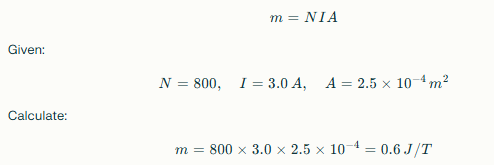
Solenoid acts like a bar magnet because it creates a similar magnetic field with north and south poles along its length.
Q4. If the solenoid in Exercise 3 is free to turn about the vertical direction and a uniform horizontal magnetic field of 0.25 T is applied, what is the magnitude of torque on the solenoid when its axis makes an angle of 30° with the direction of applied field?
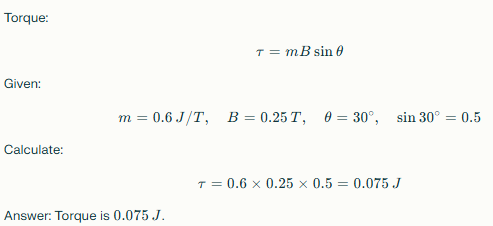
Q5. A bar magnet of magnetic moment of  lies aligned with a uniform magnetic field of 0.22 T.
(a) What is the amount of work required by an external torque to turn the magnet so as to align its magnetic moment:
(i) normal to the field direction,
(ii) opposite to the field direction?
(b) What is the torque on the magnet in cases (i) and (ii)?
Work done to rotate magnet is change in potential energy:
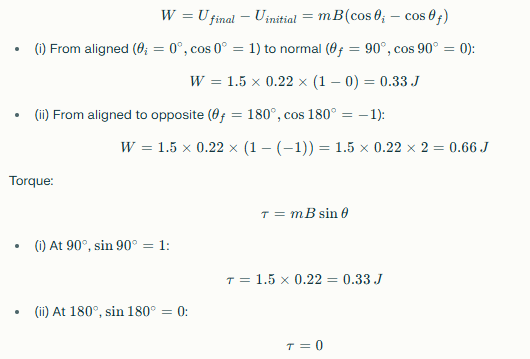
Answer:
Work (i) = 0.33 J, work (ii) = 0.66 J; torque (i) = 0.33 J, torque (ii) = 0.
Q6. A closely wound solenoid of 2000 turns and area of cross-section  , carrying a current of 4.0 A, is suspended through its centre allowing it to turn in a horizontal plane.
(a) What is the magnetic moment associated with the solenoid?
(b) What is the force and torque on the solenoid if a uniform horizontal magnetic field of  is set up at an angle of 30° with the axis of the solenoid?
(a) Magnetic moment:
F = 0
Torque:
τ = m B sinθ = 1.28 × 7.5 × 10⁻² × sin30° = 0.5 × sin30° = 0.5
τ = 1.28 × 0.075 × 0.5 = 0.048 J
Q7. A short bar magnet has a magnetic moment of 0.48 J T⁻¹. Give the direction and magnitude of the magnetic field produced by the magnet at a distance of 10 cm from the centre of the magnet on:
(a) the axis,
(b) the equatorial line (normal bisector) of the magnet.
Formulas:
Magnetic field on axis:
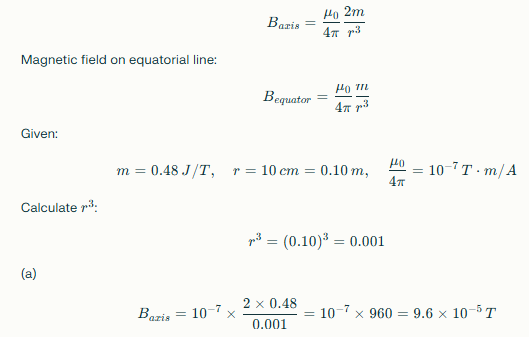
Direction: Along the axis from south to north pole.
(b)

Direction: Opposite to magnetic moment (repulsive).
Read About: Class 12 Physics Chapter 3 Current Electricity
Class 12 Physics Chapter 5 Magnetism and Matter PDF
The Magnetism and Matter NCERT pdf is very useful because it contains the full chapter explanation, all important formulas, and solved exercises at one place. You can download and study this pdf anytime, even offline. It is a great tool for revision and exam preparation because it saves your time and helps quickly review all points of chapter 5 physics class 12.
Physics Class 12 Chapter 5 Magnetism and Matter Summary
Here is the topic wise summary for Physics Class 12 Chapter 5 Magnetism and Matter:
The Bar Magnet
You learn that a bar magnet has two poles, north and south. Magnetic field lines come out of the north pole and go in through the south pole. The bar magnet acts like two tiny magnetic poles separated by a distance.
Magnetism and Gauss’s Law
This part explains that magnetic field lines always form closed loops. Unlike electric charges, magnetic poles always come in pairs—there are no isolated magnetic poles. This is shown by Gauss’s law for magnetism that states the net magnetic flux through any closed surface is zero.
Magnetisation and Magnetic Intensity
This topic shows how materials get magnetized when placed in a magnetic field. Magnetization is the measure of how much magnetic dipole moment is generated per unit volume in the material. Magnetic intensity is a related quantity to describe the field inside magnetic materials.
Magnetic Properties of Materials
Materials behave differently in magnetic fields. Some are repelled weakly (diamagnetic), some attracted weakly (paramagnetic), and some strongly (ferromagnetic). Ferromagnetic materials like iron can become permanent magnets because their tiny atomic magnets (dipoles) align strongly.
Read About: Class 12 Physics Chapter 4 Moving Charges and Magnetism
How to Learn Magnetism and Matter class 12 Physics Chapter 5 Easily
Below are simple steps to study chapter 5 physics class 12 easily and with good understanding:
- Break into parts: Divide the chapter into small sections like bar magnet, Gauss’s law, magnetisation, and properties of materials. Study one topic at a time without hurry.
- Note key formulas: Write down important formulas such as τ=mBsinθ, U=−mBcosθ, and m=NIA in one notebook for daily revision.
- Draw diagrams: Make simple diagrams of bar magnets, magnetic field lines, and solenoids to remember the shapes and directions of fields easily.
- Practice numerical questions: Solve all NCERT exercise questions step by step and try extra problems for better practice. This helps improve exam performance.
- Narrate in your own words: After reading each topic, explain it to yourself or a friend in very simple language to check your understanding.
- Connect with daily life: Think about real-life examples like fridge magnets, compass needles, and electric bell magnets to relate theory with everyday objects.
- Revise often: Keep revising chapter 5 notes regularly, not only before exams, to remember concepts better and stay confident.
Physics Class 12 Chapter 5 FAQs
Q1. How many sub-topics are in chapter 5 of Class 12 Physics?
Ans. There are 4 main sub-topics: The Bar Magnet, Magnetism and Gauss’s Law, Magnetisation and Magnetic Intensity, and Magnetic Properties of Materials.
Q2. What is the main idea or moral of this chapter?
Ans. The main idea is to understand how magnets create magnetic fields, how materials respond to these fields, and why magnetic poles always come in pairs.
Q3. Which story or concept is most important for exams in this chapter?
Ans. Torque on magnetic dipoles, magnetic moment, and magnetic behavior of materials are very important for exams.
Q4. Is this chapter mainly theory or numerical?
Ans. This chapter has both theory and numerical problems, so you should prepare well for both.
Q5. Can the Magnetism and Matter NCERT Solutions PDF help for board exams?
Ans. Yes, the Magnetism and Matter ncert pdf with solutions is very helpful because it explains concepts and provides solved questions, making exam preparation easier.